Home  /  Composers  /  Leonard Rosenman
Composer

Leonard Rosenman

1924–2008

The modernist who scored James Dean

Leonard Rosenman was born in Brooklyn in 1924. After serving in the Army Air Forces during World War II, he studied composition with Arnold Schoenberg, Roger Sessions and Luigi Dallapiccola and set out to become a modern concert composer. To pay the bills he taught piano, and one of his students was a young actor named James Dean.

Dean introduced Rosenman to director Elia Kazan, who hired him to score East of Eden (1955), Dean's first starring role. Rosenman's music, with its yearning main theme and moments of sharp dissonance, captures the raw emotion of a son desperate for his father's love. The same year he scored Rebel Without a Cause, the film that made Dean an icon of restless youth; it was released just weeks after the actor's death in a car crash.

Rosenman became known for bringing the language of 20th-century concert music, including atonality and twelve-tone technique, into Hollywood. The Cobweb (1955) is often cited as one of the first Hollywood scores to use twelve-tone writing. He also scored Fantastic Voyage, Beneath the Planet of the Apes, the animated The Lord of the Rings (1978) and Star Trek IV: The Voyage Home, which earned an Oscar nomination.

Rosenman won two Academy Awards for adapting existing music, for Stanley Kubrick's Barry Lyndon (1975) and Hal Ashby's Bound for Glory (1976), and he won Emmy Awards for his television work. He died in California in 2008.

THE ART

Music by Leonard Rosenman

Art celebrating his film scores. Click any piece to view it larger.

THE FILMS

The Story and the Score

East of Eden poster art

East of Eden (1955)

The Story

In 1917 Salinas, California, troubled young Cal Trask longs for the love of his stern, devout father, who favors Cal's brother, Aron. Cal discovers that the mother he believed dead runs a brothel in a nearby town. James Dean stars in Elia Kazan's adaptation of part of John Steinbeck's novel.

The Music

Rosenman's score captures Cal's yearning with a lyrical, aching main theme, while modern dissonances express his inner turmoil. The music deepens Dean's raw performance, giving voice to Cal's desperate need for his father's love and turning the family drama into a story of searing emotional intensity.
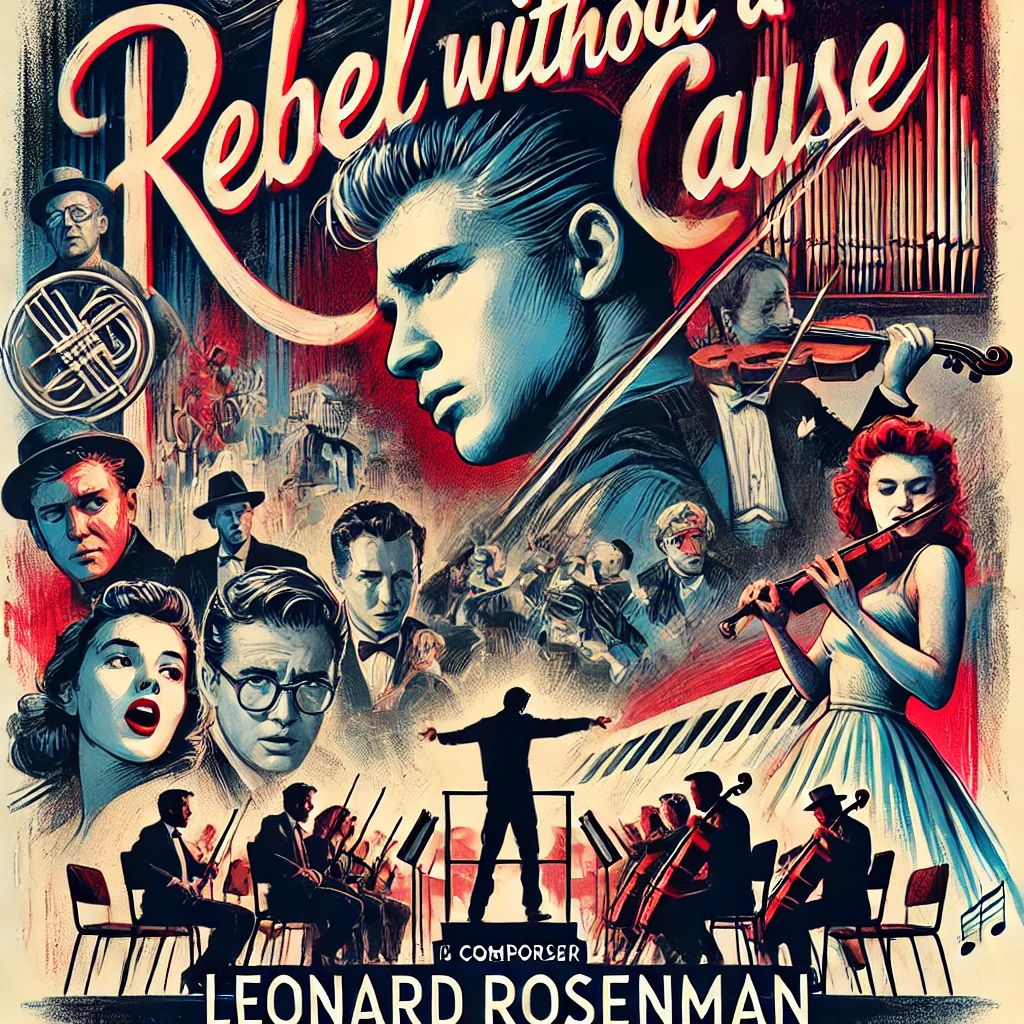
Rebel Without a Cause poster art

Rebel Without a Cause (1955)

The Story

Troubled teenager Jim Stark moves to a new town, clashes with a gang and forms friendships with Judy and the lonely, fragile Plato. A deadly "chickie run" and a night at an abandoned mansion lead to tragedy. James Dean, Natalie Wood and Sal Mineo star in Nicholas Ray's portrait of alienated youth.

The Music

Rosenman's restless, modern score, with jazz touches and sharp dissonance, captures teenage confusion and anger. Its yearning themes for Jim and his friends express a longing for belonging, while tense music builds dread before the chickie run and the final tragedy outside Griffith Observatory, making Dean's anguish almost unbearably vivid.