Home  /  Composers  /  Alex North
Composer

Alex North

1910–1991

A Streetcar Named Desire and Spartacus

Alex North was born in 1910 in Chester, Pennsylvania, to Russian Jewish immigrant parents. He studied at the Curtis Institute and Juilliard and spent time in the Soviet Union in the 1930s studying composition. Back in New York, he wrote for modern dance, documentaries and theater, working with choreographers including Martha Graham.

North's music for Elia Kazan's Broadway production of Death of a Salesman led Kazan to bring him to Hollywood for A Streetcar Named Desire (1951). It was a landmark: one of the first major Hollywood scores to draw extensively on jazz, reflecting the steamy New Orleans setting and the inner turmoil of its characters. It earned North the first of his fifteen Academy Award nominations.

His range was impressive, from the brooding Viva Zapata! and The Rose Tattoo to the epics Spartacus (1960) and Cleopatra (1963). For Spartacus, Stanley Kubrick's sweeping tale of a slave revolt, North researched ancient instruments and created a modern, often dissonant score with a tender love theme at its heart. He also co-wrote the song "Unchained Melody" for the 1955 prison film Unchained.

North's most famous disappointment came when Kubrick discarded his score for 2001: A Space Odyssey in favor of classical recordings, a story that has fascinated film music fans ever since. Although he never won a competitive Oscar, in 1986 he became the first composer to receive an Honorary Academy Award. He died in Los Angeles in 1991.

THE ART

Music by Alex North

Art celebrating his film scores. Click any piece to view it larger.

THE FILMS

The Story and the Score

A Streetcar Named Desire poster art

A Streetcar Named Desire (1951)

The Story

Fading Southern belle Blanche DuBois arrives in New Orleans to stay with her sister, Stella, and Stella's brutish husband, Stanley Kowalski. Blanche's fragile illusions clash with Stanley's raw aggression, driving her toward breakdown. Vivien Leigh and Marlon Brando star in Elia Kazan's adaptation of Tennessee Williams's play.

The Music

North's Oscar-nominated score uses jazz to express the characters' passions and the steamy New Orleans atmosphere. Sultry blues define Stanley's world, while a haunting polka tied to Blanche's past reveals her fragility. The score changed how Hollywood used jazz in serious drama, opening the door to a decade of jazz-influenced film music.
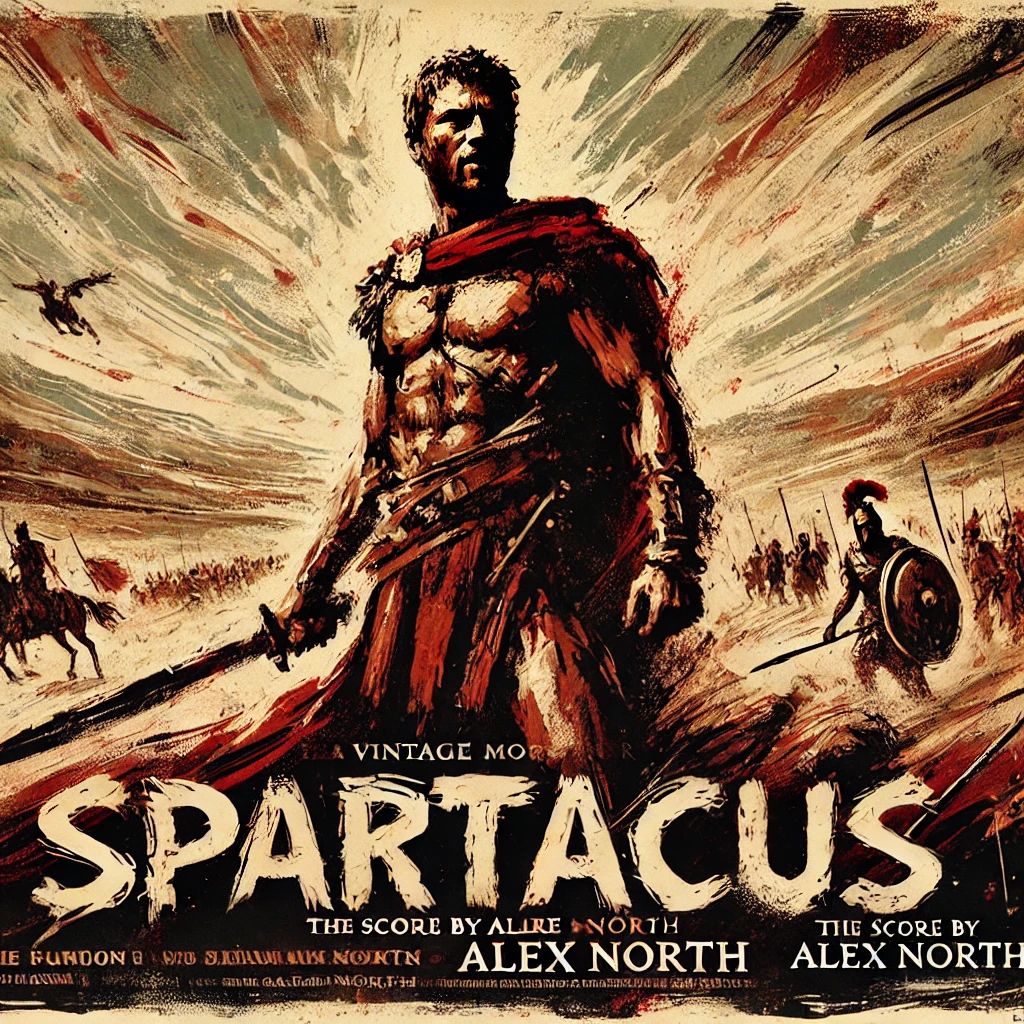
Spartacus poster art

Spartacus (1960)

The Story

Thracian slave Spartacus is trained as a gladiator and leads a massive revolt against Rome. His army of escaped slaves wins battle after battle but finally faces the legions of the ruthless Crassus. Kirk Douglas, Laurence Olivier and Jean Simmons star in Stanley Kubrick's epic, which won four Academy Awards.

The Music

North's Oscar-nominated score uses bold, modern, often dissonant writing to suggest Rome's power and brutality, while a tender love theme for Spartacus and Varinia gives the epic its heart. Brass and percussion drive the battles, and the music makes the slaves' struggle for freedom deeply moving.