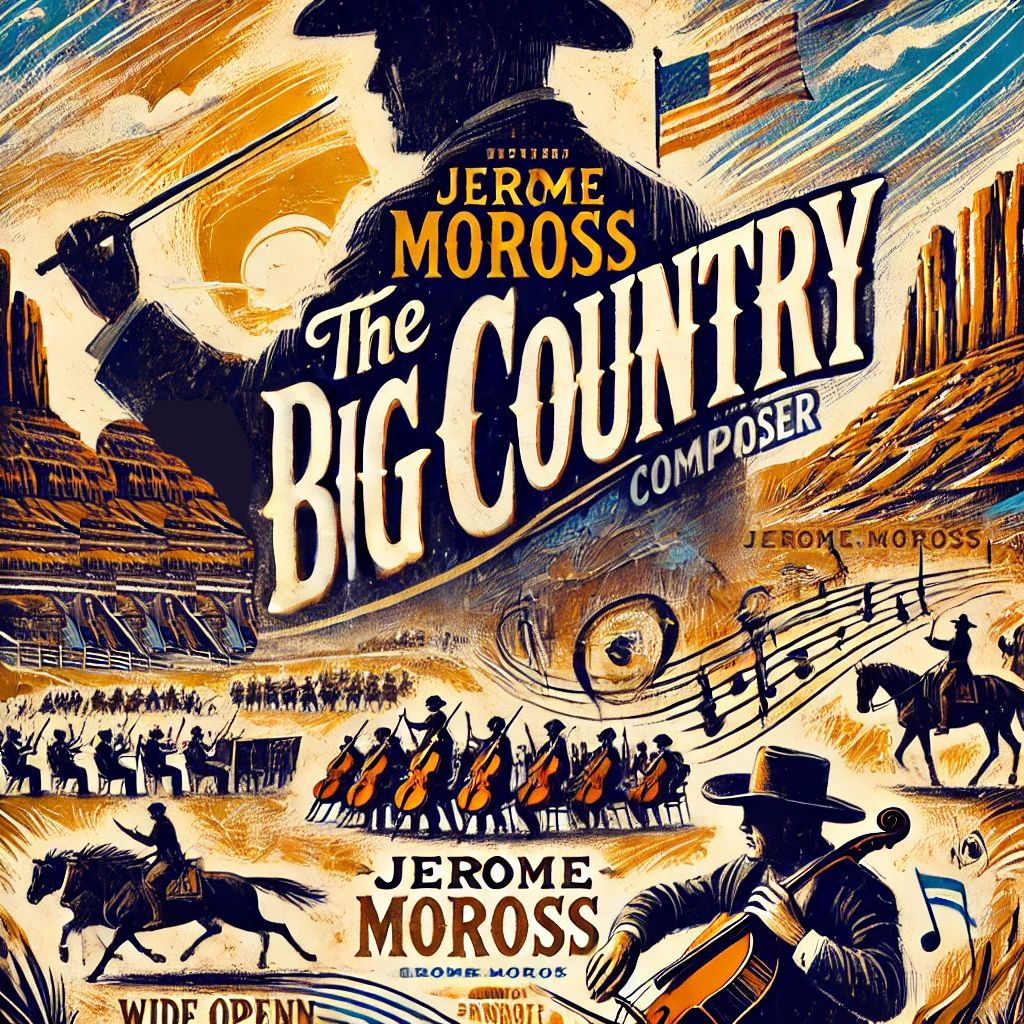
Jerome Moross was born in Brooklyn in 1913 and showed musical talent early, graduating from New York University while still a teenager. In the 1930s he wrote ballets, theater music and concert works, and he became close to Bernard Herrmann, who championed his music. His ballet Frankie and Johnny and his 1954 musical The Golden Apple, written with John Latouche, were admired for their fresh, distinctly American sound.
Moross came to Hollywood in the 1940s as an orchestrator, working on scores by Aaron Copland, Hugo Friedhofer and others, before establishing himself as a composer. His style drew on American folk song, hymns and dance rhythms, which made him a natural for Westerns.
His most famous score, for William Wyler's The Big Country (1958), is often considered the greatest Western score ever written. Its galloping main theme, driven by brass and pounding rhythm, captures the vastness of the open range, and it earned Moross an Oscar nomination. The music has become a concert favorite and is widely recognized even by people who have never seen the film.
Moross went on to score The Proud Rebel, The Adventures of Huckleberry Finn (1960), The Jayhawkers, The Cardinal and The War Lord, and he wrote the theme for the television series Wagon Train. Although his output was relatively small, his music had a lasting influence on the sound of the American West on screen. He died in Miami in 1983.