Home  /  Composers  /  Ernest Gold
Composer

Ernest Gold

1921–1999

The Exodus theme

Ernest Gold was born Ernst Goldner in Vienna in 1921. He composed his first pieces as a child and studied at the Vienna State Academy of Music, but in 1938, after Nazi Germany annexed Austria, his Jewish family fled to the United States. In New York he worked as an accompanist and wrote popular songs before moving to Hollywood in the mid-1940s, where he spent years scoring low-budget films and working as an orchestrator.

His breakthrough came in the late 1950s with producer-director Stanley Kramer. On the Beach (1959), about survivors of a nuclear war, wove the Australian song "Waltzing Matilda" into a haunting score that earned an Oscar nomination.

Gold's greatest success came the following year with Otto Preminger's Exodus (1960), the epic story of the founding of the State of Israel. Its stirring main theme, both triumphant and yearning, won Gold the Academy Award and became a worldwide hit in many versions, including a popular instrumental recording by the piano duo Ferrante and Teicher. For a Viennese refugee who had escaped the Nazis, the subject held deep personal meaning.

Gold continued to work with Kramer on Inherit the Wind, Judgment at Nuremberg, It's a Mad, Mad, Mad, Mad World and Ship of Fools. He was married to singer Marni Nixon, the uncredited singing voice of stars in The King and I, West Side Story and My Fair Lady, and their son is singer-songwriter Andrew Gold. Ernest Gold died in 1999.

THE ART

Music by Ernest Gold

Art celebrating his film scores. Click any piece to view it larger.

THE FILMS

The Story and the Score

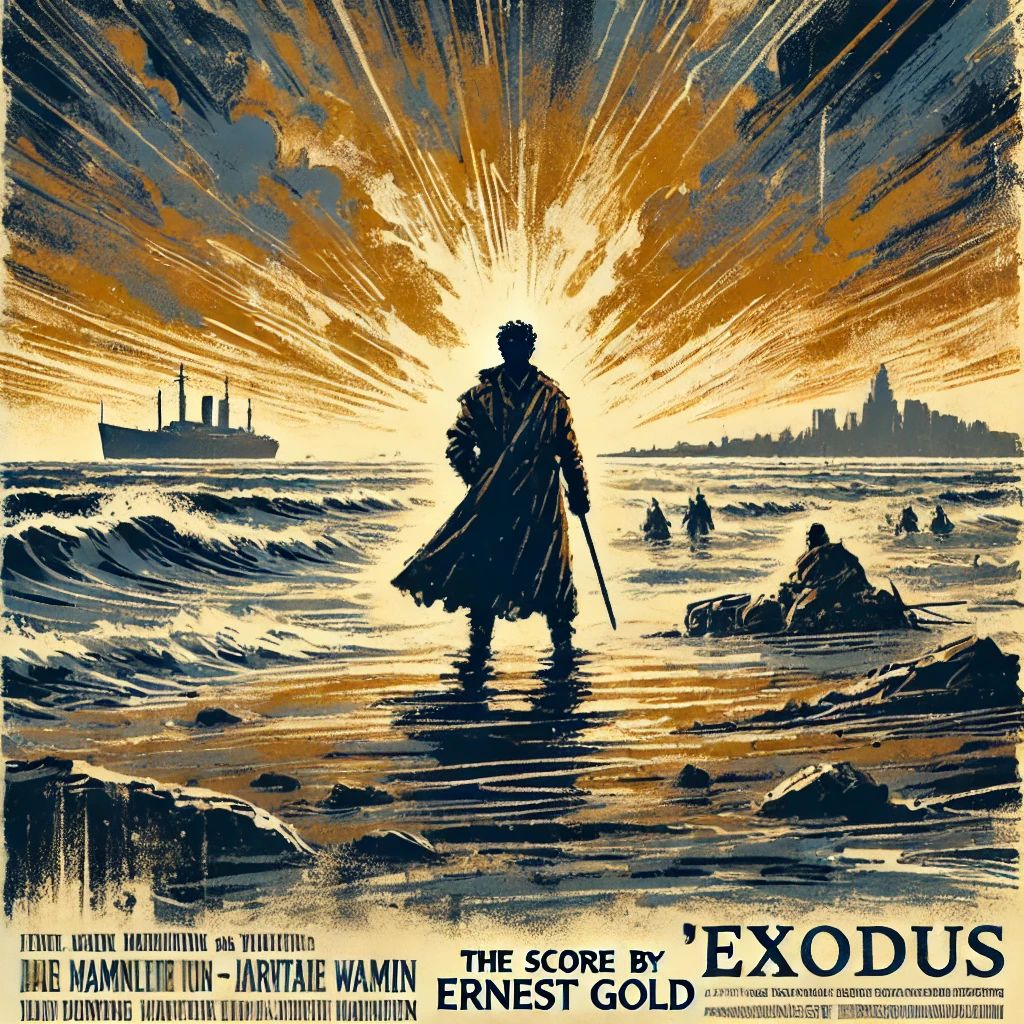
Exodus poster art

Exodus (1960)

The Story

In 1947, Ari Ben Canaan, a leader of the Jewish underground, smuggles Holocaust survivors from a British detention camp in Cyprus to Palestine aboard the ship Exodus. Amid conflict, the State of Israel is born. Paul Newman and Eva Marie Saint star in Otto Preminger's epic, based on Leon Uris's novel.

The Music

Gold won the Oscar for this score, whose stirring main theme, both triumphant and yearning, became a worldwide hit. The music conveys the survivors' hope and the struggle for a homeland, and its emotional power helped make the film an epic of national rebirth. Ferrante and Teicher's piano recording became a best-selling single.